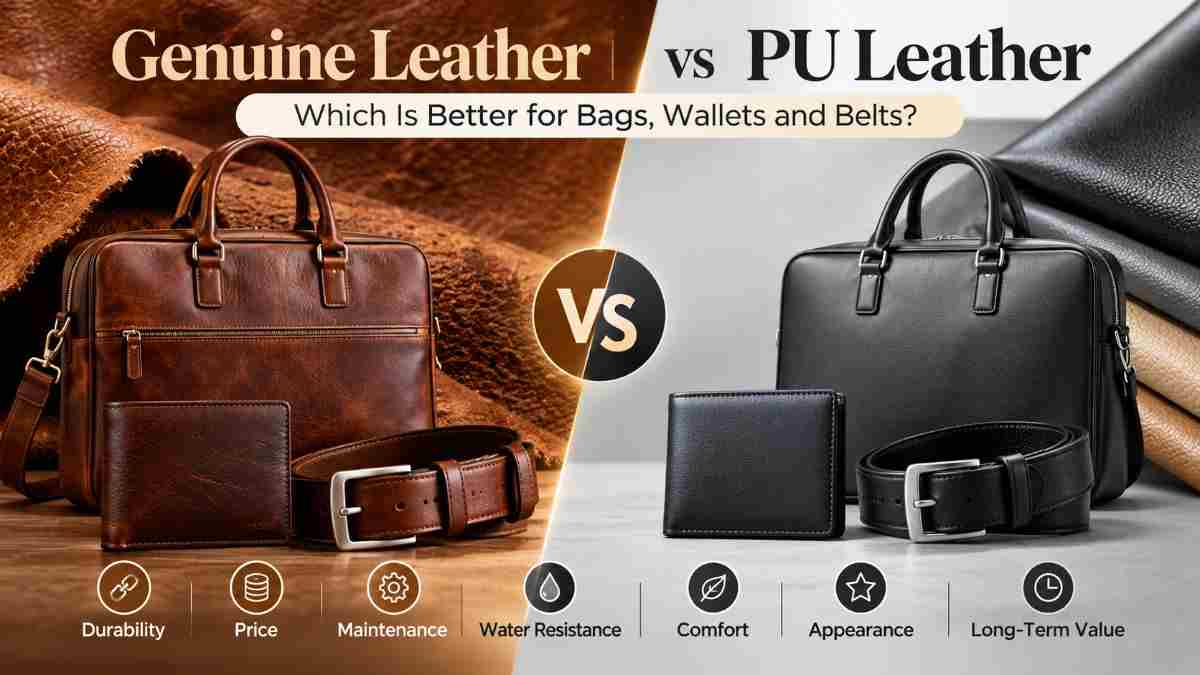
When shopping for a bag, wallet, or belt, you may notice products described as genuine leather, PU leather, synthetic leather, or faux leather. Although these materials can look similar, they differ in composition, durability, maintenance, appearance, and long-term value.
The main difference between genuine leather vs PU leather is the material used. Genuine leather is made from animal hide, while PU leather is a synthetic material that typically consists of a polyurethane coating applied to a textile or other backing.
Genuine leather is often preferred for accessories intended for long-term use because suitable leather can develop character and remain serviceable with proper care. PU leather can provide an affordable alternative with a consistent appearance and a wide range of colors and finishes.
However, neither material is automatically the best choice for every product. Quality, construction, coating, usage, and maintenance all influence performance.
This guide compares genuine leather and PU leather to help you choose suitable materials for handbags, office bags, wallets, belts, and everyday accessories.
Genuine leather is a material produced from animal hide through tanning and finishing processes that make it suitable for manufacturing consumer products.
The tanning process stabilizes the hide, while finishing techniques influence its appearance, flexibility, texture, and resistance to everyday wear.
Leather is commonly used to manufacture:
Different leather grades and finishes offer different properties. A heavily coated lower-quality leather product may behave very differently from a well-made full-grain leather accessory.
Leather On Call offers leather bags designed for different professional, personal, and travel requirements.
PU leather, or polyurethane leather, is generally a synthetic leather-like material manufactured by applying a polyurethane layer to a fabric or other backing.
The surface may be embossed or finished to imitate the grain and appearance of natural leather.
PU leather is used in products such as:
Manufacturers can produce PU leather in a wide range of colors, textures, and surface patterns.
Its quality depends on the coating formulation, backing material, manufacturing process, and overall product construction.
Some PU-coated materials are made with leather-based substrates, so buyers should check the complete material composition rather than relying on the term PU alone.
Genuine leather and PU leather differ primarily in their material structure and how they respond to use, moisture, heat, and aging.
| Feature | Genuine Leather | PU Leather |
|---|---|---|
| Material | Animal hide processed through tanning | Polyurethane-based coating with a supporting substrate |
| Surface Texture | Depends on natural grain and finishing | Can be manufactured with uniform or embossed textures |
| Durability | Can be long-lasting with suitable quality and care | Depends on coating quality and resistance to deterioration |
| Aging | Some finishes develop a natural patina | Coatings may crack, peel, or deteriorate over time |
| Water Resistance | Varies considerably by finish | Coated surfaces often resist brief moisture exposure |
| Breathability | Varies according to thickness and finish | Often more restricted by synthetic surface coatings |
| Maintenance | Requires finish-specific cleaning and care | Usually requires gentle surface cleaning |
| Price | Often more expensive | Often more affordable |
| Appearance | Natural variations may be visible | Can offer consistent colors and patterns |
| Common Applications | Premium bags, wallets, belts, and accessories | Fashion accessories and cost-sensitive products |
These are general characteristics. Actual performance depends on the specific product materials, manufacturing quality, and intended use.
Well-made genuine leather products often offer better long-term durability than lower-quality PU leather alternatives.
Natural leather has a fibrous structure that can provide strength and flexibility when properly processed and maintained.
High-quality leather bags and wallets may remain functional for years, although their surfaces can still experience scratches, staining, stretching, and other forms of wear.
PU leather relies partly on a synthetic surface coating. With prolonged use, repeated bending, heat, moisture, or aging, some PU coatings may begin to crack or peel.
However, it is important to distinguish high-quality PU leather from inexpensive, poorly manufactured synthetic products.
A well-made PU accessory may perform better than a poorly constructed leather product.
When comparing durability, examine:
The material is important, but product construction also affects how long a bag, wallet, or belt remains usable.
PU leather can peel or crack when its polyurethane coating deteriorates or separates from the underlying material.
This process may be accelerated by:
Some polyurethane materials are susceptible to hydrolytic degradation, where moisture and chemical reactions gradually weaken the material.
Genuine leather does not have the same construction as ordinary PU-coated fabric, but finished leather can still experience surface coating damage, cracking, or delamination.
Not every leather product develops an attractive patina, and not every PU product deteriorates quickly.
Correct maintenance and material quality remain important for both options.
For bags intended for regular professional or long-term use, genuine leather can be a worthwhile choice when durability, repairability, and material character are important.
For fashion-focused or budget-sensitive purchases, PU leather may be attractive because of its affordability and variety of finishes.
Office and laptop bags experience regular handling, weight loading, and contact with different surfaces.
Good-quality leather can provide a combination of flexibility, appearance, and durability for these applications.
However, suitable handles, reinforced stitching, secure zippers, and padded compartments are also essential.
A genuine leather laptop bag with poor construction may perform worse than a carefully manufactured alternative.
PU leather may be suitable when the buyer prioritizes:
Buyers should still inspect the quality of the surface coating, straps, stitching, and hardware.
Both material and construction matter.
Look closely at the stress points where handles, straps, and zippers connect to the bag.
Good stitching, reinforced joints, secure hardware, and appropriate lining materials can improve the functionality of either material.
Wallets experience frequent folding, friction, and contact with pockets, bags, and hands.
Genuine leather is often preferred for everyday wallets because it can remain flexible and develop a distinctive appearance over time.
PU leather wallets may be suitable for occasional use or buyers seeking an affordable accessory with a particular design.
When choosing between materials, consider:
Explore different leather wallets to compare designs based on storage capacity, material construction, and everyday requirements.
Belts experience repeated bending, tension, and friction during regular wear.
A well-made leather belt can offer useful flexibility and long-term durability when its material thickness, construction, and finishing are appropriate.
PU leather belts may provide an economical alternative for occasional wear or fashion-oriented use.
However, some synthetic coatings can crack or separate around frequently bent areas, especially near the buckle and adjustment holes.
Before purchasing a belt, check:
Buyers can explore leather belts in different styles for formal, casual, and everyday requirements.
PU leather often has a coated surface that resists limited moisture exposure, making it relatively easy to wipe clean.
However, PU leather is not necessarily waterproof. Water may still enter through seams, damaged areas, fabric backings, or openings.
Genuine leather's water resistance depends heavily on its finish.
For example, some protected leather finishes resist brief contact with water, while suede, nubuck, and unfinished leather can be more sensitive to moisture.
Neither material should automatically be considered suitable for heavy rain or prolonged water exposure.
For leather products, excess moisture should be gently blotted and the item allowed to dry naturally, following manufacturer care instructions.
Natural leather can allow some moisture vapor transmission, but its breathability varies according to the tanning process, surface coatings, thickness, and construction.
PU-coated materials often have more limited breathability because of their synthetic surface layer.
However, breathability is not equally important for every leather accessory.
For bags and wallets, flexibility, weight, surface feel, and construction may have a greater influence on comfort.
For belts, material stiffness, thickness, fit, and buckle placement are especially relevant.
Do not assume all genuine leather is softer or lighter than PU leather, because both materials are available in different forms.
Both materials benefit from gentle cleaning, but their care requirements are different.
For suitable smooth, finished leather, remove loose dust with a soft cloth.
If the manufacturer permits light damp cleaning, use a barely damp microfiber cloth and avoid excessive moisture.
For deeper cleaning, use a product specifically compatible with the leather finish.
Some leather finishes may benefit from appropriate conditioning, while others require different treatments.
Many PU leather surfaces can be cleaned using a soft cloth lightly dampened with water, provided the product manufacturer's instructions allow it.
Avoid harsh solvents, abrasive tools, strong detergents, and excessive moisture.
Do not apply natural leather conditioners to PU leather unless the product manufacturer specifically recommends them.
PU leather generally does not absorb traditional leather conditioners in the same way as uncoated natural leather.
The appropriate cleaning method should always follow the actual material and finish rather than a generic online recommendation.
High-quality genuine leather can provide a long service life when properly used and maintained.
Its fibrous structure can remain functional even as the material develops signs of use.
PU leather lifespan varies significantly according to coating formulation, storage environment, mechanical stress, and manufacturing quality.
Some synthetic products may develop surface deterioration before their stitching or underlying fabric wears out.
However, there is no universal lifespan that applies to every leather or PU product.
To estimate long-term value, consider:
A higher purchase price does not automatically guarantee a longer service life.
Genuine leather products are often more expensive than PU leather alternatives because of raw material costs, hide processing, material selection, and manufacturing requirements.
However, prices can vary widely depending on the product and brand.
The final cost is influenced by:
For frequent daily use, evaluating cost per year of satisfactory service may be more useful than comparing purchase prices alone.
For occasional fashion use, a lower-cost PU accessory may provide adequate value.
Neither genuine leather nor PU leather can be described as universally more environmentally friendly without considering the complete production and disposal processes.
Natural leather production involves animal hides, tanning chemicals, water, energy, and other processing resources.
PU leather commonly uses synthetic polymer materials, which are often derived from fossil-based feedstocks.
Environmental impacts can include:
Some PU materials are made with alternative formulations, while leather manufacturers may use different tanning and processing practices.
Buyers concerned about environmental impact should look for credible material traceability, relevant certifications, and product-specific evidence instead of assuming either material is automatically sustainable.
PU leather is commonly marketed as vegan leather when it contains no animal-derived materials.
However, the broader term vegan leather can describe several different material types, including synthetic, plant-based, and composite alternatives.
Not every product marketed as vegan leather is made entirely from plant-based materials.
Likewise, some products described as PU-coated leather may contain an animal-hide substrate.
Consumers should verify the full material composition when avoiding animal-derived ingredients is important.
Visual appearance alone is not a reliable way to identify genuine leather.
Modern synthetic materials can reproduce natural-looking grain patterns, while finished genuine leather can have a very uniform surface.
Before purchasing, check the product description and material information.
Useful details include:
Do not rely exclusively on smell, surface texture, or price to identify the material.
Water-drop tests, burning tests, and aggressive scratching can permanently damage accessories and are not recommended as routine buying checks.
The best material depends on how frequently the accessory will be used and which features matter most.
| Product or Requirement | Material Worth Considering | Main Reason |
|---|---|---|
| Daily office bag | Good-quality genuine leather | Long-term use and professional appearance |
| Occasional fashion handbag | PU leather or genuine leather | Choice depends on style, price, and expected use |
| Everyday wallet | Good-quality genuine leather | Flexibility and potential long-term durability |
| Occasional-use wallet | PU leather or genuine leather | Budget and personal preference |
| Daily formal belt | Properly constructed genuine leather | Frequent bending and wear requirements |
| Fashion belt | PU leather or genuine leather | Style, price, and usage frequency |
| Animal-free material preference | Verified animal-free synthetic alternative | Avoidance of animal-derived materials |
These recommendations are general. A well-made product should be evaluated on its full construction rather than material alone.
Before purchasing leather accessories, evaluate how the material and product construction suit your needs.
Use the following checklist:
For wholesale purchasing, additional checks may include sample approval, material consistency, color matching, dimensional tolerances, and production quality control.
PU leather usually refers to a synthetic polyurethane-coated material rather than natural leather. However, some PU-coated products contain leather-based substrates, so checking the complete material composition is important.
It depends on product quality and usage. Well-made genuine leather can offer excellent long-term durability, while PU leather performance depends on the coating, backing, and environmental conditions.
Some surface damage may be concealed or treated using specialist products, but widespread coating delamination is often difficult to repair permanently. Replacement may be more practical when deterioration is extensive.
No. Water resistance depends on the leather finish, product construction, and protective treatments. Many genuine leather products can be damaged by excessive moisture.
Yes, a well-made PU leather bag may suit everyday use, but its durability depends on material and construction quality, handling, and environmental exposure.
Genuine leather may be preferable for frequent long-term use, while PU leather can be a practical lower-cost alternative. Design, stitching, thickness, and storage layout are also important.
No. Patina development depends on the leather type and finish. Heavily coated or pigmented leather may show fewer natural color changes than some minimally finished leathers.
Environmental impact depends on material formulation, production, durability, and disposal. PU leather should not automatically be considered environmentally friendly simply because it is synthetic or animal-free.
The choice between genuine leather and PU leather depends on your budget, intended use, material preferences, and expectations for durability.
Genuine leather may be a better choice when you want an accessory for frequent use, appreciate natural material characteristics, and are prepared to follow suitable maintenance practices.
PU leather may be more practical when affordability, consistent surface appearance, and particular fashion designs are the main priorities.
For bags, wallets, and belts, construction quality remains just as important as the material itself. Strong stitching, reliable hardware, suitable finishing, and practical design all contribute to product performance.
Leather On Call offers a range of leather bags, wallets, belts, and other accessories for personal, professional, and wholesale requirements.
Before choosing a product, compare material composition, construction quality, care requirements, and expected usage to select an accessory that provides suitable value over time.