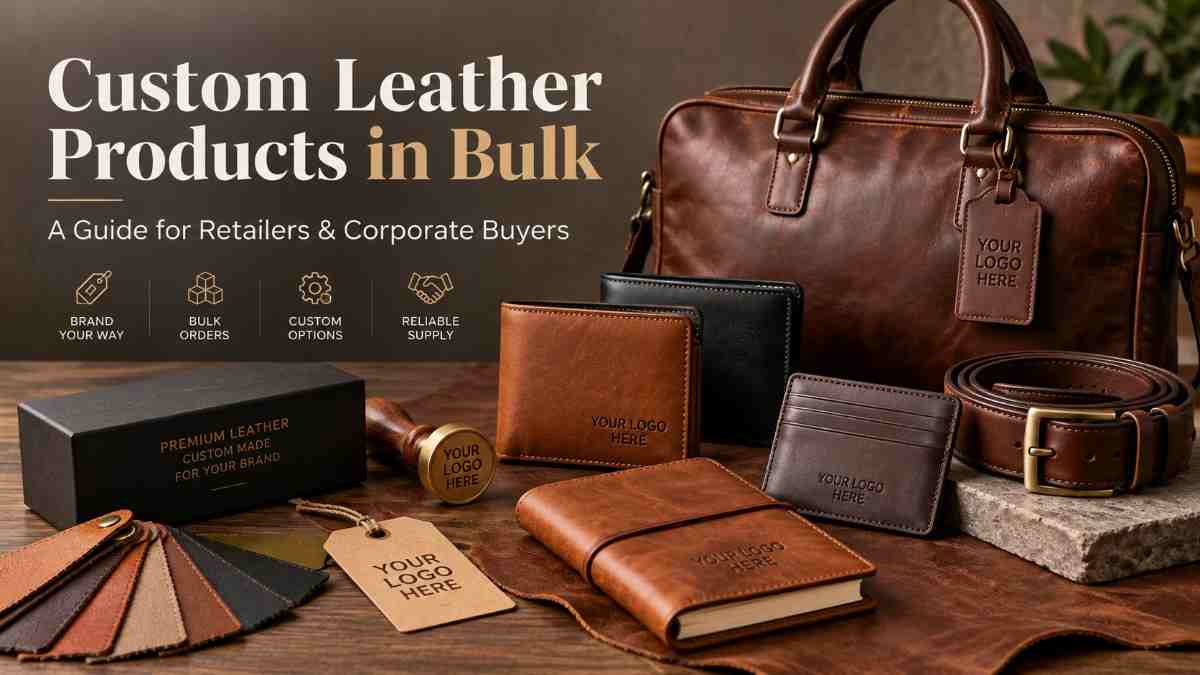
Ordering custom leather products in bulk can be an effective way for retailers, corporate gifting companies, distributors, and private-label brands to source accessories that match their business requirements. However, bulk purchasing involves more than selecting a product and requesting a quotation.
Buyers must consider leather quality, product specifications, branding methods, minimum order quantities, sample approvals, production timelines, packaging, and quality control before placing an order.
The best way to order custom leather products in bulk is to define your requirements, shortlist suitable products, discuss customization options with the manufacturer, approve a sample, and confirm commercial terms before production begins.
Whether you need custom leather wallets for a retail collection, branded card holders for a corporate event, or leather bags for employee gifting, a structured purchasing process can reduce misunderstandings and improve order consistency.
This guide explains how to plan wholesale leather goods orders, evaluate manufacturers, compare customization methods, and prepare the details required for an accurate quotation.
Custom leather products are accessories manufactured or personalized according to specific design, branding, material, size, or packaging requirements.
Businesses may order these products in bulk to maintain consistent branding, support promotional campaigns, create retail collections, or provide practical gifts to employees and customers.
Common bulk leather products include:
Bulk orders can help businesses maintain consistent product specifications across multiple units while simplifying procurement and distribution.
However, the benefits depend on supplier capabilities, product quality, order quantities, and the agreed manufacturing terms.
A well-planned bulk order generally follows a series of purchasing and approval stages.
Following these steps helps reduce errors related to product dimensions, branding, material selection, and delivery expectations.
The best corporate leather gifts are practical, suitable for the intended recipients, and easy to personalize without compromising their functionality.
Different accessories serve different gifting purposes.
| Leather Product | Common Business Use | Potential Customization |
|---|---|---|
| Leather Wallets | Employee gifts, client appreciation, festive gifting | Logo embossing, color selection, packaging |
| Leather Card Holders | Conferences, business events, onboarding kits | Logo placement, color, branded packaging |
| Leather Belts | Retail collections and selected employee gifting | Color, buckle style, packaging |
| Leather Laptop Bags | Employee welcome kits, executive gifts | Logo, dimensions, internal compartments |
| Leather Journals | Meetings, conferences, promotional gifts | Debossing, initials, custom covers |
| Leather Keychains | Promotional campaigns and giveaways | Logo and color customization |
Leather wallets and card holders are often convenient for gifting because they are compact and generally do not require individual clothing-size information.
Leather bags may provide greater perceived value for selected corporate programs, but they typically require a larger budget and more detailed specifications.
Retailers should select leather products according to their target customers, expected selling prices, product positioning, and available inventory budget.
A premium accessories retailer may prioritize distinctive materials and detailed finishing, while a value-focused store may require simpler designs that meet specific price targets.
Before selecting products, evaluate:
Retailers can explore leather wallets when planning collections with different storage layouts, including compact, bifold, trifold, and other wallet designs.
Starting with a focused product range can make it easier to evaluate customer demand before expanding into additional styles.
Minimum Order Quantity, commonly called MOQ, is the smallest number of units a supplier agrees to manufacture or supply under specific commercial terms.
There is no universal MOQ for custom leather products.
The required quantity may vary according to:
For example, adding a logo to an existing wallet design may involve different production requirements from developing an entirely new leather bag with customized dimensions and compartments.
Buyers should ask whether the MOQ applies to the entire order, each product style, each color, or each branding variation.
Leather On Call provides bulk order and customization enquiry options. The applicable MOQ should be confirmed directly for the selected products rather than assumed.
Material selection influences the appearance, flexibility, cost, durability, and maintenance requirements of leather accessories.
Buyers should define the required material specifications before requesting a quotation.
Full-grain leather retains the natural grain surface and can be suitable for premium accessories where durability and natural material characteristics are important.
However, full-grain leather is not automatically appropriate for every design, finish, or budget.
Its appearance may include natural variations, which should be considered when uniformity is important across a large production batch.
Top-grain leather generally undergoes surface processing that can help produce a more consistent appearance.
Depending on the finishing method, it may be suitable for wallets, bags, and other accessories requiring a particular texture or color.
The term alone does not establish the complete quality of the finished product.
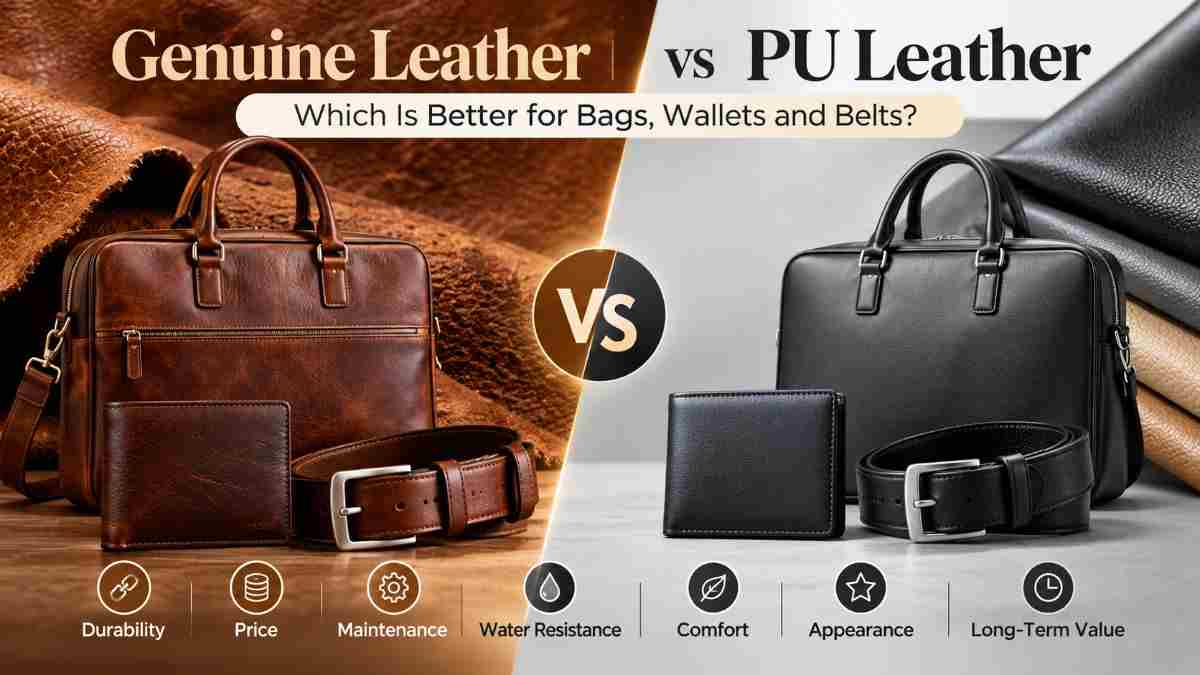
Genuine leather and synthetic leather-like materials offer different combinations of price, appearance, durability, and maintenance requirements.
The correct choice depends on the intended product positioning and customer expectations.
Before confirming a bulk order, ask the supplier to describe the actual material composition rather than relying only on broad marketing labels.
Customization can include changes to product appearance, branding, construction, and packaging.
Available methods depend on the product material and supplier's manufacturing capabilities.
Embossing creates a raised design, while debossing creates a recessed impression on the material surface.
These methods are commonly considered for wallets, journals, card holders, and other accessories.
Logo size, leather finish, depth, and placement influence the final appearance.
Before confirming an order, buyers should request a sample or approved artwork proof.
Foil stamping uses a suitable process to apply a metallic or colored finish to a design.
It may be used for logos, initials, and other decorative branding elements.
However, foil suitability and durability depend on the leather surface, process settings, and product use.
Confirm the available colors and finish compatibility before approving production.
Leather bags may be personalized through suitable logo placement, material colors, lining options, and selected construction changes.
Businesses considering leather bags for corporate gifting should confirm logo dimensions, available placement areas, and the required storage features.
Not every customization option will be available for every bag design.
Packaging can influence how recipients perceive a corporate gift.
Depending on the supplier, available options may include:
Buyers should confirm packaging specifications, quantities, artwork requirements, and additional charges before approving the order.
Wholesale leather product pricing depends on materials, design, customization, quantity, production requirements, and delivery terms.
There is no single fixed price suitable for every custom leather product.
Important cost factors include:
When comparing quotations, buyers should confirm what is included in the stated price.
A lower unit price may not represent better value if important costs such as packaging, inspection, shipping, or customization are excluded.
The total landed cost provides a more complete view of the purchase than the basic product price alone.
A simplified calculation is:
Total Order Cost = Product Cost + Customization + Packaging + Sampling + Shipping + Applicable Taxes and Duties
For example, consider an illustrative order of 200 wallets.
| Cost Component | Illustrative Amount |
|---|---|
| 200 wallets at ?250 each | ?50,000 |
| Logo customization | ?3,000 |
| Packaging | ?4,000 |
| Sampling | ?1,500 |
| Shipping | ?2,500 |
| Total before applicable taxes | ?61,000 |
In this example, the average cost is ?305 per wallet before applicable taxes.
These figures are hypothetical examples used to explain procurement calculations. They are not Leather On Call's actual prices or quotations.
For a more accurate comparison, request an itemized quotation based on the actual specifications and delivery location.
Sample approval is an important quality-control step when ordering customized products.
A sample allows buyers to evaluate the physical item before committing to full production.
Important checks include:
Samples should be evaluated against documented specifications rather than appearance alone.
Buyers should confirm whether the approved sample will serve as the reference standard for production.
Any requested changes should be documented before the final purchase order is confirmed.
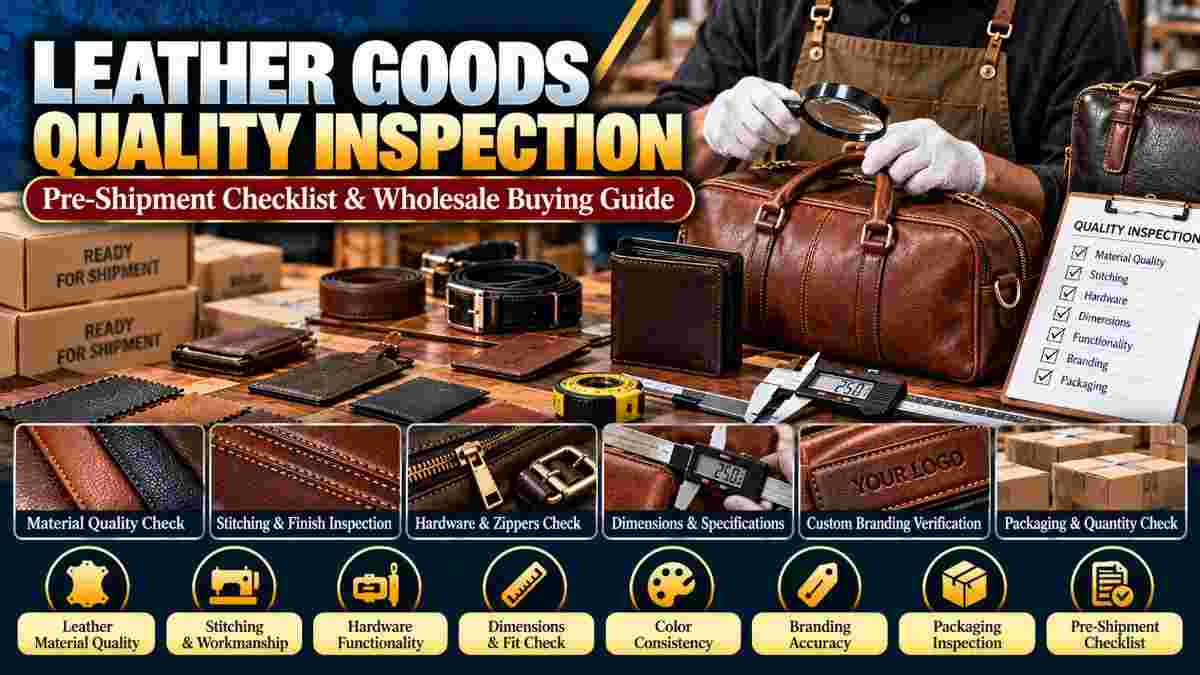
Quality inspection helps ensure that bulk products meet agreed specifications and remain consistent across the shipment.
Inspection requirements should be discussed before production begins.
Review the material type, thickness, finish, flexibility, and expected appearance.
Natural leather may contain variations in grain, shade, and texture, so buyers should define what level of variation is acceptable.
Inspect seam alignment, thread quality, stitch consistency, and reinforced stress points.
Uneven stitching, loose threads, or weak attachment points may affect appearance and product performance.
Operate zippers, buckles, magnetic closures, and other components to check their functionality.
Confirm that hardware finishes and dimensions match the approved specifications.
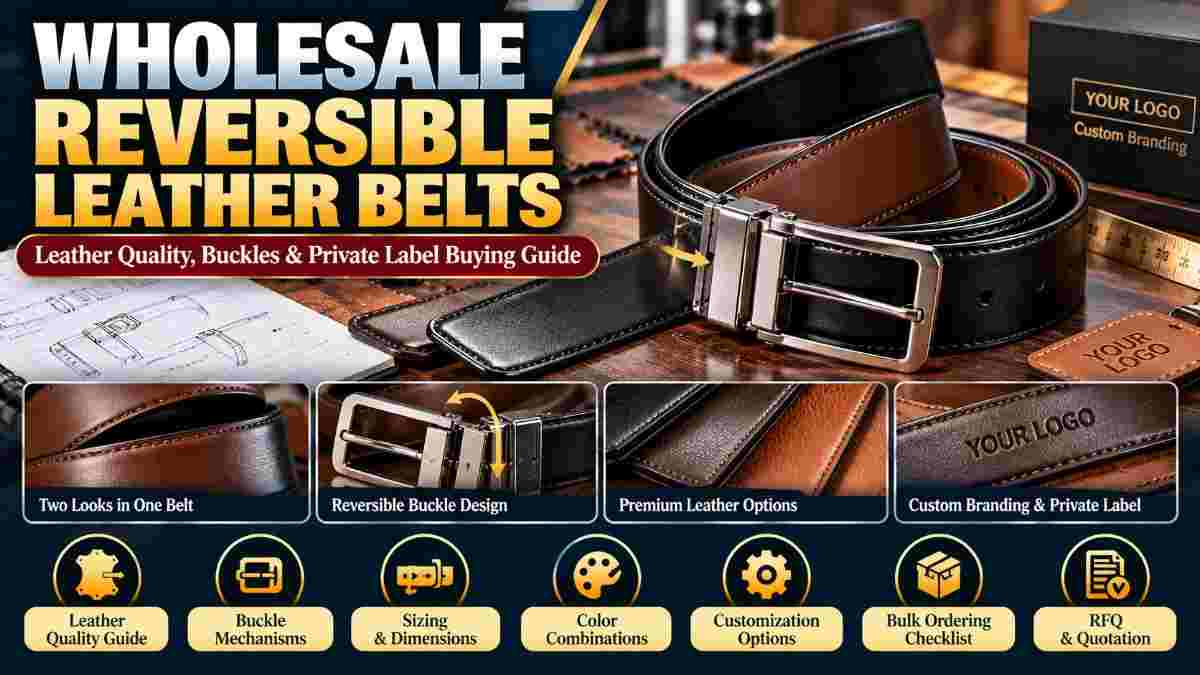
For leather belts, buckle quality, strap dimensions, hole placement, and edge finishing deserve particular attention.
Compare production samples against the approved logo reference.
Verify placement, orientation, size, depth, color, and clarity where applicable.
Quality tolerances should be agreed before production rather than decided only after delivery.
Production lead time varies according to the selected product, order quantity, material availability, customization requirements, and manufacturing schedule.
A basic order using an existing design may require less development work than a new private-label product with custom patterns, fittings, and packaging.
The complete timeline may include:
Buyers should request a written production schedule and distinguish the manufacturing completion date from the expected delivery date.
For time-sensitive corporate events, additional schedule allowance can help accommodate approvals, revisions, and shipping delays.
Wholesale purchasing generally involves buying products in quantity for resale, distribution, or organizational use.
Private-label manufacturing involves supplying products under the buyer's brand, subject to agreed branding and manufacturing arrangements.
| Factor | Wholesale Leather Products | Private-Label Leather Products |
|---|---|---|
| Product Design | Often based on existing supplier designs | May include buyer-specific designs or modifications |
| Branding | May be standard or customized | Typically uses the buyer's branding |
| Development Work | Often limited | May require design and sample development |
| Order Quantity | Depends on supplier terms | May vary with customization requirements |
| Packaging | Standard or customized | Often brand-specific |
| Lead Time | Depends on stock and production | May be longer for new designs |
Businesses planning private-label products should also clarify ownership of designs, artwork, tooling, and any exclusivity arrangements.
Not every wholesale supplier offers complete private-label development services, so these capabilities should be confirmed before placing an order.
The appropriate product category depends on the retailer's customer profile and planned selling price.
Wallets, card holders, belts, and selected bags can be considered because they offer different size, design, and pricing possibilities.
For example, leather card holders may be worth evaluating for compact accessory collections.
Retailers can compare the required material, branding options, production quantity, packaging, and expected retail margin before selecting the final product range.
A limited initial assortment can make it easier to evaluate customer demand and supplier consistency before expanding into additional designs.
Before selecting a supplier, prepare questions covering product quality, customization, commercial terms, and delivery.
Important questions include:
Written confirmation of these details helps both the buyer and supplier understand the agreed requirements.
Bulk purchases involve larger quantities and financial commitments, so small specification errors can affect many units.
Common mistakes include:
A detailed product specification, approved sample, and written purchase order can reduce many of these risks.
A clear enquiry helps suppliers understand the project and prepare a relevant quotation.
Include the following information:
For example, a corporate buyer requesting 300 branded wallets should specify whether the order requires one design, multiple colors, individual gift boxes, and a particular delivery deadline.
Providing these details early helps minimize repeated clarification and supports more accurate pricing.
Yes, company-logo personalization is available for many leather wallet designs, depending on the supplier's capabilities and the material finish. Confirm the logo application method, size, placement, and MOQ before ordering.
MOQ varies by manufacturer, product, materials, and customization requirements. Buyers should request the minimum quantity for the specific style and branding variation they need.
Yes. Wallets, card holders, laptop bags, journals, and keychains can be suitable for employee gifts, client appreciation, conferences, and other corporate programs.
Private-label arrangements may be available through manufacturers offering suitable branding or product-development services. Confirm the supplier's capabilities, design requirements, and commercial terms before placing an order.
Provide the product type, quantity, material, dimensions, logo details, packaging, delivery location, and required date. Ask the supplier to itemize customization, shipping, and other applicable charges.
Yes. Sample approval helps confirm product dimensions, material appearance, stitching, branding, hardware, and other details before full production begins.
Many leather products can be supplied in different colors, subject to material availability and supplier capabilities. Minimum quantities and additional charges may apply to each color variation.
Embossing creates a raised design, while debossing creates a recessed design. The available method depends on the leather finish and the manufacturer's equipment.
Compare material specifications, sample quality, manufacturing capabilities, total pricing, MOQ, production lead time, quality-control requirements, and delivery terms rather than price alone.
Ordering custom leather products in bulk requires careful planning, clear specifications, and reliable communication between the buyer and manufacturer.
Retailers should focus on consistent product quality, appropriate pricing, and dependable repeat supply. Corporate buyers should prioritize product suitability, accurate branding, packaging, and delivery requirements.
Leather On Call is an India-based leather products manufacturer and supplier offering wallets, belts, bags, card holders, and other leather accessories. The website also provides enquiry options for bulk orders and customization.
Before confirming a purchase, discuss the available product options, customization requirements, MOQ, sample approval process, pricing, and production schedule with the supplier.
To explore products or request a quotation for your business, visit Leather On Call or use the contact page to share your bulk order requirements.